Machines That Remember Nothing: The Vanishing Craft at the Heart of British Laboratory Science
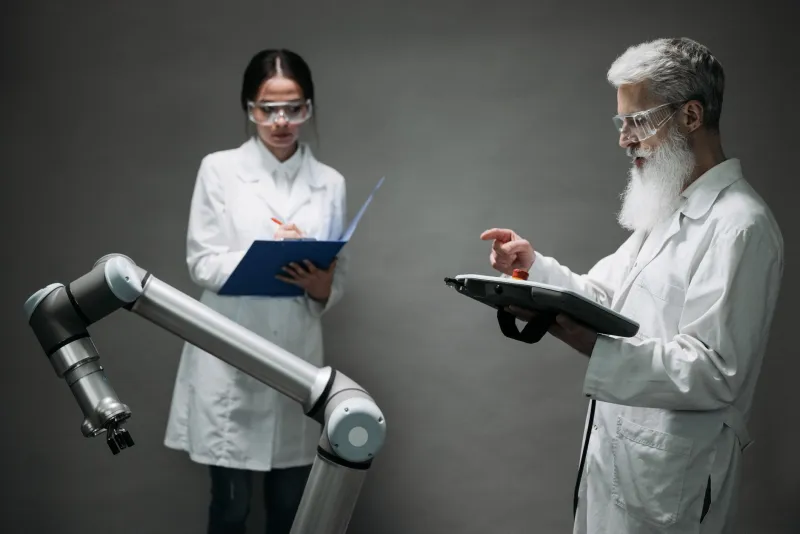
There is a particular kind of knowledge that cannot be written into a protocol. It lives in the slight resistance a pipette offers when a cell suspension is correctly homogenised, in the faint discolouration that tells an experienced biochemist a reagent has degraded before any instrument confirms it, in the instinct — developed across thousands of repetitions — that something about an experiment is subtly wrong before the data returns. Scientists call it tacit knowledge. Increasingly, Britain's research institutions are automating it out of existence.
Across the United Kingdom, from the Wellcome Sanger Institute in Hinxton to the Francis Crick Institute in London, laboratory automation has accelerated sharply over the past decade. Liquid-handling robots, automated imaging platforms, and high-throughput screening systems have transformed the pace and scale at which biological and chemical data can be generated. The benefits are real and not trivial: reproducibility improves, human error diminishes, and research outputs that once required months of manual work can now be achieved in days. Funding bodies, including UK Research and Innovation, have actively encouraged the transition, framing automation as integral to the country's ambitions for world-leading science.
Yet a growing number of senior researchers are voicing an anxiety that rarely surfaces in grant applications or institutional strategies: that in optimising the process of science, the profession may be quietly degrading the practice of it.
The Knowledge That Cannot Be Codified
The philosopher Michael Polanyi introduced the concept of tacit knowledge in the 1950s, arguing that skilled practitioners know far more than they can explicitly articulate. His observation — that we know how to ride a bicycle without being able to fully explain the physics of balance — applies with particular force to experimental science. A crystallographer who has grown protein crystals for thirty years carries within them a repository of sensory and inferential knowledge that no manual, however detailed, can fully encode.
Professor Sarah Holt, a structural biologist at a Russell Group university who asked to be identified only by a pseudonym due to concerns about institutional relationships, describes the problem in practical terms. "When I trained in the 1990s, I spent two years doing everything by hand. I failed constantly. Those failures taught me things I still use every day — why certain buffers behave unexpectedly, how temperature fluctuations affect crystallisation in ways that the textbooks understate. My PhD students now interact with a system that has been optimised to succeed. They are very good at running it. But when it fails, or when they need to do something it wasn't designed for, they are sometimes genuinely lost."
This is not a nostalgic argument against technological progress. The concern is more specific and more structural: that the apprenticeship model through which tacit knowledge has historically been transmitted is being dismantled faster than any alternative transmission mechanism has been developed.
Early-Career Researchers at the Interface
For postdoctoral researchers and doctoral candidates — already navigating precarious employment conditions, as this publication has previously explored — the automation question carries particular weight. Many entered science during a period when robotic platforms were already standard fixtures in well-resourced laboratories. Their training has been shaped accordingly.
Dr James Okafor, a postdoctoral researcher in molecular biology at a northern English university, is candid about the gaps this creates. "I am genuinely excellent with the automated systems we use. I can troubleshoot software errors, optimise protocols within the system's parameters, and generate data at a scale my supervisor's generation couldn't have imagined. But there are moments — when something unexpected happens, when the system produces an anomaly — where I notice that I don't have the same intuitive framework for interpreting it that the senior people in my department seem to have. They look at something and they know. I look at it and I run another analysis."
This distinction matters not merely for individual competence but for the broader trajectory of discovery. Scientific breakthroughs have historically emerged not from the smooth execution of anticipated experiments but from the capacity to recognise and pursue the unexpected. Alexander Fleming's observation of bacterial inhibition around a contaminating mould was not the output of a high-throughput screen. It required a trained eye, an interpretive habit, and the confidence to deviate from the original experimental intention.
Institutional Incentives and the Efficiency Trap
The pressures driving automation are not irrational. The Research Excellence Framework rewards outputs — publications, citations, demonstrable impact — and automated systems generate outputs with greater speed and consistency than manual approaches. For laboratory heads managing fixed-term contracts, shrinking grant periods, and institutional pressure to publish, the incentive to automate is powerful and understandable.
But Dr Priya Menon, a science policy researcher at the University of Edinburgh, argues that the REF framework, in combination with funding models that reward throughput, has created a structural misalignment. "We have built a system that is very good at measuring what machines produce and not very good at measuring what experienced human scientists know. The result is that institutions invest heavily in the former and neglect the conditions necessary to develop the latter. Training time, mentorship, the freedom to do slow, exploratory, manual work — these are all being squeezed."
Several respondents to this investigation noted that the problem is compounded by the attrition of experienced researchers from academic science. As senior scientists retire or migrate to industry, the tacit knowledge they carry is not systematically captured. It simply disappears.
Towards a More Deliberate Pedagogy
Not everyone accepts that the situation is as dire as its critics suggest. Some researchers argue that the nature of tacit knowledge is itself evolving — that a new generation of scientists is developing deep intuition about computational systems, data pipelines, and algorithmic behaviour that is no less sophisticated than the bench skills of their predecessors, merely differently constituted.
There is something to this. The ability to identify a spurious signal in a large dataset, or to recognise when a machine-learning model is overfitting to noise, represents a genuine form of expert judgement. But others counter that these competencies, while valuable, do not substitute for the embodied understanding of biological and chemical systems that experimental science ultimately requires.
Some institutions are beginning to respond. A handful of UK universities have introduced structured manual laboratory components into doctoral training programmes, explicitly designed to ensure that students develop hands-on skills before transitioning to automated workflows. The Biochemical Society has convened working groups to examine how tacit knowledge transmission can be formalised within mentorship frameworks.
These are modest interventions against a powerful current. Whether they prove sufficient will depend, in large part, on whether funding bodies and research institutions are willing to acknowledge that the speed of discovery is not the only metric by which the health of science should be judged.
The Longer View
British science has historically drawn part of its strength from a culture of rigorous, hands-on training — a tradition stretching from the Victorian natural philosophers through to the molecular biologists of the twentieth century who built reputations on extraordinary experimental dexterity. That tradition is not incompatible with automation. But it requires conscious protection.
The machines that now populate Britain's laboratories are, in many respects, remarkable achievements. They do not tire, they do not introduce the inconsistencies of human fatigue, and they can execute in hours what once took months. What they cannot do is wonder. They cannot notice, in the way that a trained scientist notices, that something unexpected is happening and that it might matter. They carry no memory of the thousands of small failures from which expertise is built.
If the institutions responsible for training the next generation of British scientists do not find ways to preserve and transmit the knowledge that machines cannot hold, they risk producing a research community that is, in a precise and troubling sense, only as innovative as the systems it has been trained to operate.


